




By Joseph T. Sefcik, Founder and President

Hiring the right people is one of the most important decisions an organization makes. To improve hiring outcomes, many organizations are adopting a performance-based approach.
So, what exactly is performance-based hiring?
Performance-based hiring is a recruitment approach that focuses on selecting candidates based on their ability to perform the essential responsibilities of a role. It emphasizes demonstrated skills and measurable results rather than relying on resume screening or general interview impressions.
Performance is the key difference.
Traditional hiring methods like interviews, resumes, or past job titles are largely based on inferred ability. These approaches depend heavily on the accuracy of the information provided and the judgment of the reviewer.
In contrast, performance-based hiring places more emphasis on direct evidence of ability, such as observable actions and achieved outcomes.
At its core, performance-based hiring rests on three key principles:
First, the performance must be observable. In other words, there must be clear evidence that an action was taken; something that can be seen, reviewed, or verified.
Second, the observed performance must be directly related to success in the role. What is evaluated should clearly connect to the responsibilities and outcomes required for the job.
Finally, the actions must be measurable in a way that can be quantified reliably and consistently, indicating the level of proficiency.
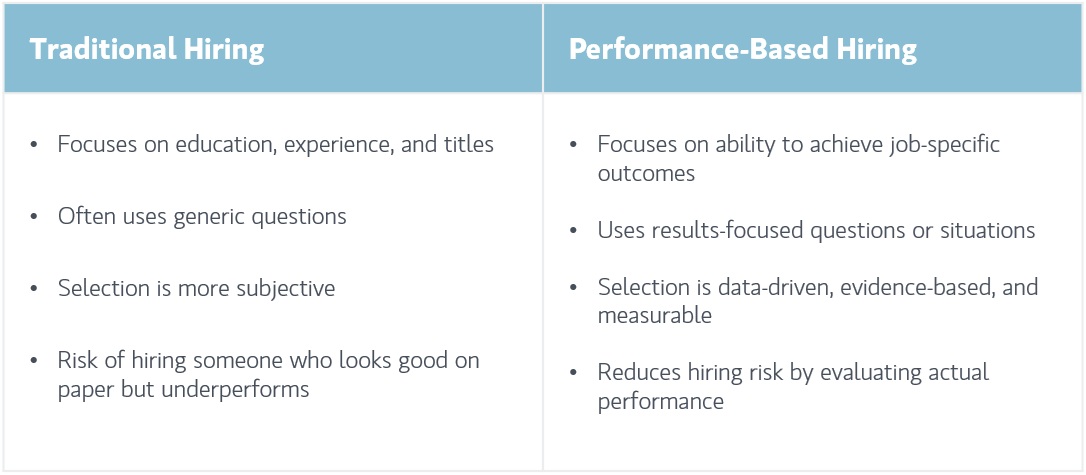
The real difference between the two hiring methods is that performance-based hiring relies on objective, data-driven evaluation while traditional hiring depends more on intuitive and subjective judgment.
A portfolio of a candidate’s work product, a collection of examples of an individual’s work.
Realistic scenarios that replicate key workplace tasks and challenges, requiring candidates to demonstrate their job-related abilities.
Direct assessments of specific abilities, such as typing tests for speed and accuracy or coding tests to evaluate programming expertise.
Descriptions of job situations for candidates to review, analyze, and respond by describing actions they would take.
Structured interviews that include questions about job situations for candidates to describe similar experiences and the actions taken.
Hiring decisions are grounded in observable data rather than impressions, reducing internal questions such as, “Why was that person hired?”
Grounded in scientific data-driven methods, the accuracy of performance-based solutions in predicting on-the-job success is significantly higher.
Evaluations focus on demonstrated performance, which reduces the influence of superficial factors and subjective bias.
Because performance-based tools closely reflect the job, candidates typically perceive them as more engaging, fair, and informative.
By evaluating actual ability, organizations can quickly identify qualified and unqualified candidates, reducing time and cost to hire.
This comparison highlights the shift from evaluating credentials and impressions to evaluating job-specific capabilities and outcomes.
No. Resumes can still provide background information. However, they are written to make an impression and should be considered after data-driven performance criteria.
Yes, most roles can incorporate performance-based elements. The approach may vary depending on the job type, but defining measurable outcomes is applicable across all jobs and industries.
These tools typically streamline the hiring process, saving recruiting time and resources by quickly identifying the most qualified candidates.
It uses standardized criteria and objective measures of performance, minimizing reliance on personal impressions or subjective judgments.
The first step is defining clear, measurable performance outcomes for the role. Once these are established, assessments and interview questions can be chosen to evaluate those outcomes directly.
Performance-based hiring centers on the principle that the best predictor of future success is demonstrated ability. By aligning hiring methods with measurable job-relevant performance, organizations can make more informed, consistent, and defensible hiring and employee development decisions.
Understanding time-to-hire: A Key Metric in Recruitment
Looking for new ways to streamline your recruiting process, drive better hiring decisions, improve engagement and retention, or boost bottom-line results? Reach out to talk with our team of HR Experts about how new technologies and best practices can address your unique needs and challenges.
Get your questions answered with NO OBLIGATION. Schedule your free consultation today.